Artist interview – Loredana di Cianni
Loredana Di Cianni is a painter, a writer, and the founder of a movement ViVismo, which she created herself, is a philosophy of creation rooted in inner listening, trust in the unconscious, and the courage to let the hand lead where the eye cannot follow. When I first encountered her ViVe, those hypercoloured feminine presences that exist somewhere between dream and memory, I knew she had to be part of Marea Gallery.
Loredana paints with her eyes closed. It is a conscious method, a deliberate act of surrender that bypasses rational control and reaches something deeper: the neuronal, the retinal, the dreamlike. The result are paintings that shift depending on what you, as the viewer, bring to them. Each ViVa carries an identity that is simultaneously Loredana’s and yours.
This conversation moves through her inner world, through the origins of ViVismo, through the relationship between painting and writing, through colour as energy, and through what it means to create with your eyes closed. In reading these pages, you encounter an artist who has chosen trust in herself, in the process, in the unexpected.
Tamara Perusic, curator, Marea Gallery
Loredana, tell us a little about yourself – who are you, where are you from, and how did your journey as an artist and writer begin?
I am Loredana Di Cianni, artist and writer. I am a person who has always felt the need to express herself through images and words, to give form to what can often not be explained rationally. My artistic path was born from a deep listening to myself, from that inner part that observes the world not only through the eyes, but also through emotions, intuitions and imagination. Painting and writing have become two different, yet complementary ways of exploring this space.
I do not consider art merely a form of expression, for me it is a way of knowing, of discovering and, sometimes, of allowing myself to be surprised by what emerges without having been planned. Over time, this research gave life to ViVismo and to my ViVe, feminine presences that inhabit my paintings and that, in some way, have also found a voice through writing.
You founded the ViVismo movement. What is ViVismo and how did it come about?
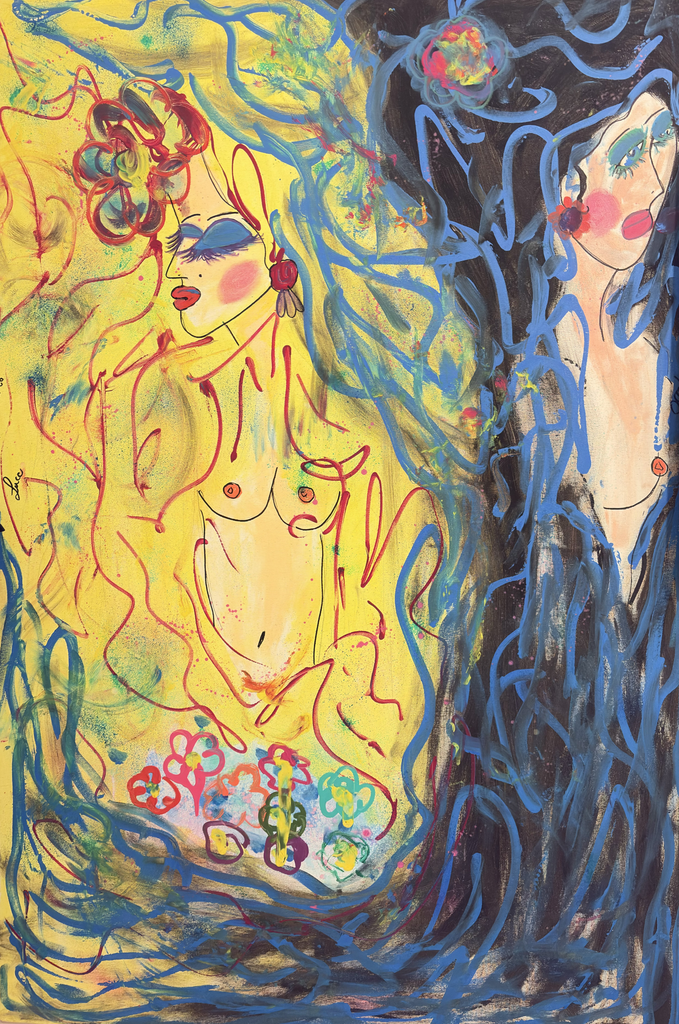
ViVismo was born from the need to give a name to a way of creating and perceiving reality that I felt deeply as my own. The word itself evokes life, vitality, something that moves and continues to transform. For me, ViVismo is an artistic approach in which I entrust myself to a creative process that does not necessarily start from rational control, but from inner listening and the freedom of gesture. It is an invitation to allow what lives inside us to emerge, without immediately imposing a form, a meaning or an explanation.
My ViVe represent this principle – they are women who manifest themselves on the canvas with their energy, their colours and their expressions. They are not born to respond to an aesthetic ideal, but to exist, to tell their story and to communicate. ViVismo is also a form of trust: trust in intuition, in the unexpected, and in the possibility that, by leaving space for the deepest part of ourselves, something authentic may emerge.
You say that you paint and write through a kind of neuronal, retinal, dreamlike, reptilian process. Can you describe what actually happens when you begin to create? What does this experience feel like from the inside?
Creating with eyes closed means, for me, shifting attention from what I see outside to what I feel inside. When I paint, I try to suspend rational judgement as much as possible. I do not necessarily start from a precise image to reproduce – I entrust myself to the gesture, to the movement of the hand, to the sensations and to what surfaces during the process. It is like entering an inner space in which thought, memory, emotion and imagination can meet without having to follow a predetermined order.
When I speak of the neuronal, retinal, dreamlike and reptilian dimension, I am trying to describe precisely this complexity: the dialogue between perception, visual memory, dream images and more instinctive, bodily and immediate responses. It is an act of trust. For a moment I give up the need to know in advance where I will arrive. And it is precisely in this renunciation that, paradoxically, I find a form of freedom.
Your ViVe are hypercoloured women who appear to you and tell you their stories. Who are they? Do they come from dreams, from memories, from something else? Do you have control over them or do they guide you?
My ViVe are feminine presences that take form through the creative process. They have faces, expressions and colours that seem to hold something greater than the simple representation of a figure. I would not be able to trace them back to a single origin. Within them can coexist fragments of memory, emotions, inner images, dreamlike suggestions and aspects of human experience that we do not always know how to recognise immediately.
I do not consider them portraits of specific women. They are rather individualities that, through painting, acquire their own identity. The relationship I have with them is particular – I am the one who paints, but I am not always the one who decides everything. There is a part of the process in which I let myself be guided by what emerges, without trying to correct it to bring it back to an already established image.
It is as if a dialogue were established between me and the canvas. I offer the gesture and the colour; the image takes form and, in turn, suggests something to me. Perhaps this is precisely the fascination of the ViVe: they are not only creatures I paint, but presences through which I continue to discover something about myself and others.
You work with acrylics and use bold outlines alongside expressive brushstrokes. How did this visual language develop? Was it a conscious choice or did it emerge on its own?
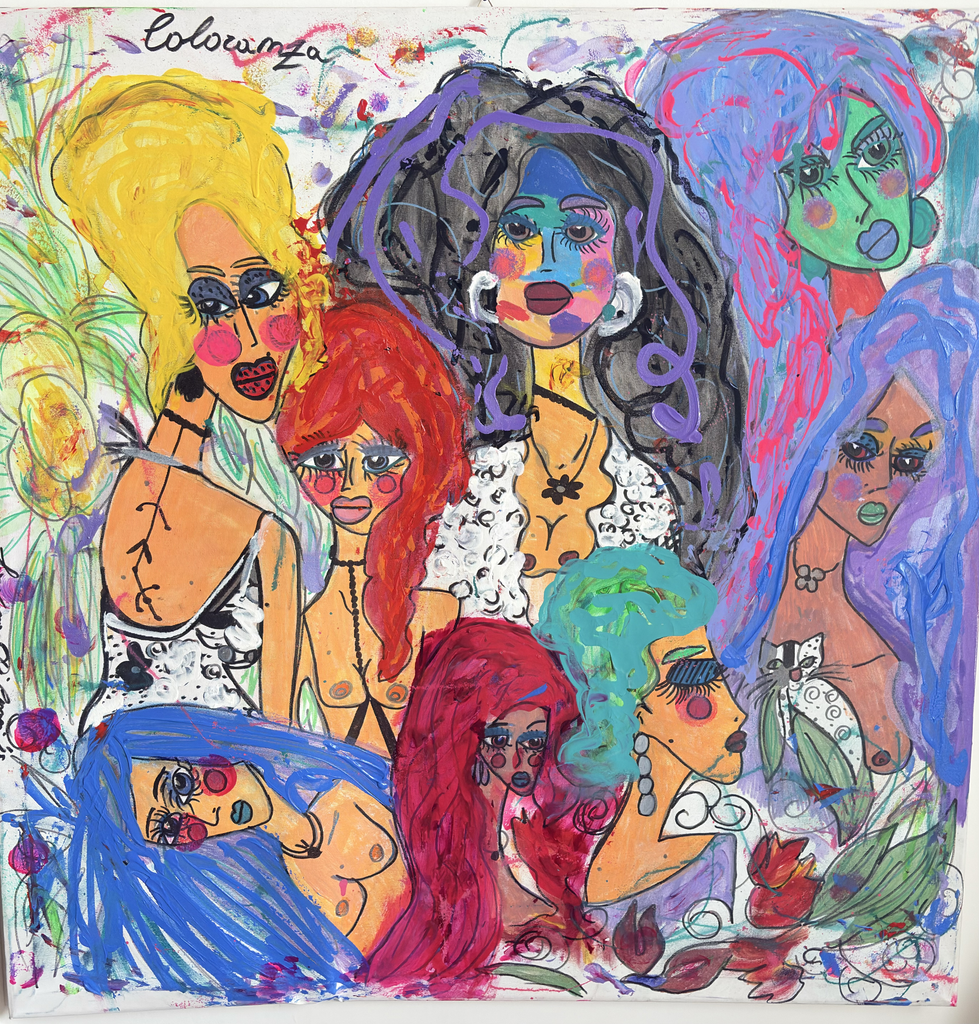
My visual language developed through gesture, experimentation and the freedom to let colour find its own space. Acrylics allow me to work with immediacy, to layer tones, create contrasts and follow the rhythm of the composition. Colour is not only a tool for describing a figure – it is a presence that contributes to defining its character and energy. The bold outlines give the ViVe their recognisability, while the freer brushstrokes preserve the spontaneity of the process. I am interested in this coexistence between definition and instinct, between what appears sharp and what remains open to interpretation.
I do not believe that every element of my language was born from a conscious decision. Some characteristics manifested over time, through practice, until they became part of my artistic identity. It was a journey in which I learned to recognise my own way of expressing myself, without feeling the need to bring it back to predetermined rules.
Colour plays a dominant role in your paintings – vivid reds, electric blues, deep purples. How do you choose colours when you paint with your eyes closed?
Colour, for me, is a form of energy and communication. Even before it is something we observe, it can be something we feel. When I paint with my eyes closed, colour does not necessarily arise from a rational visual choice. I entrust myself to the gesture, to the memory of colours and to the sensations that lead me towards a particular tone. Of course, painting with eyes closed does not mean that the final result is foreign to the visual dimension, my relationship with colour has also been shaped through experience, knowledge of materials and sensitivity developed over time.
Red can suggest vitality, passion or intensity; blue can open a deeper and more mysterious space; purple can evoke a suspended, almost dreamlike dimension. But I do not like to attribute a rigid meaning to colours, valid for every work. Each colour changes in relation to those around it, to the figure it accompanies and to the emotion that the whole manages to convey. In my ViVe, colour does not only serve to make a woman recognisable, it contributes to telling the story of her presence.
Some of your works carry Italian or Greek titles, and one of your paintings is called Marea -which is also the name of this gallery and of your latest novel. How intertwined are painting and writing for you?
For me, painting and writing are two languages born from the same need to give form to what moves inside us. Painting can tell without explaining, while writing can accompany the reader inside a story, through words, thoughts and the emotions of the characters. In both, however, I am interested in what is not immediately visible.
The title Marea suggests to me a continuous movement, something that arrives, withdraws and returns transformed. It is an image I feel close to my creative universe, because inspiration too has a rhythm that we cannot always control. There are moments in which images seem to precede words, and others in which a word opens a visual space. I do not believe that one of the two languages must necessarily explain the other I prefer that they can dialogue while each maintains its own autonomy.
The fact that Marea is also the name of this gallery makes this encounter particularly meaningful. It is as if a title could pass through different artistic forms and continue to generate new associations. In the end, both when I paint and when I write, I try to approach something I do not yet fully know. This is what keeps the research alive.
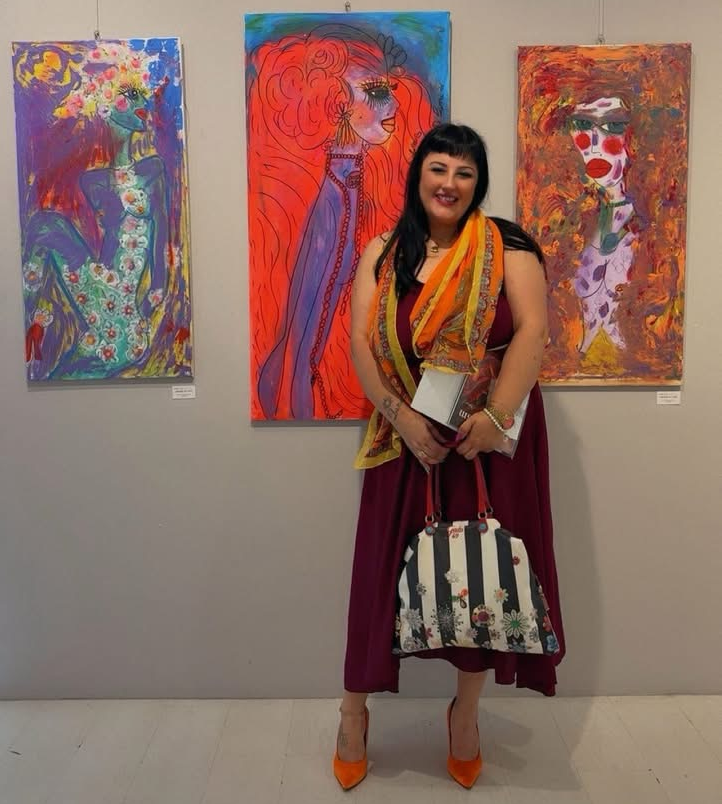
You have exhibited nationally and internationally. How do you feel when you see your ViVe on the walls of a gallery, and how does the public react when they discover how they are born?
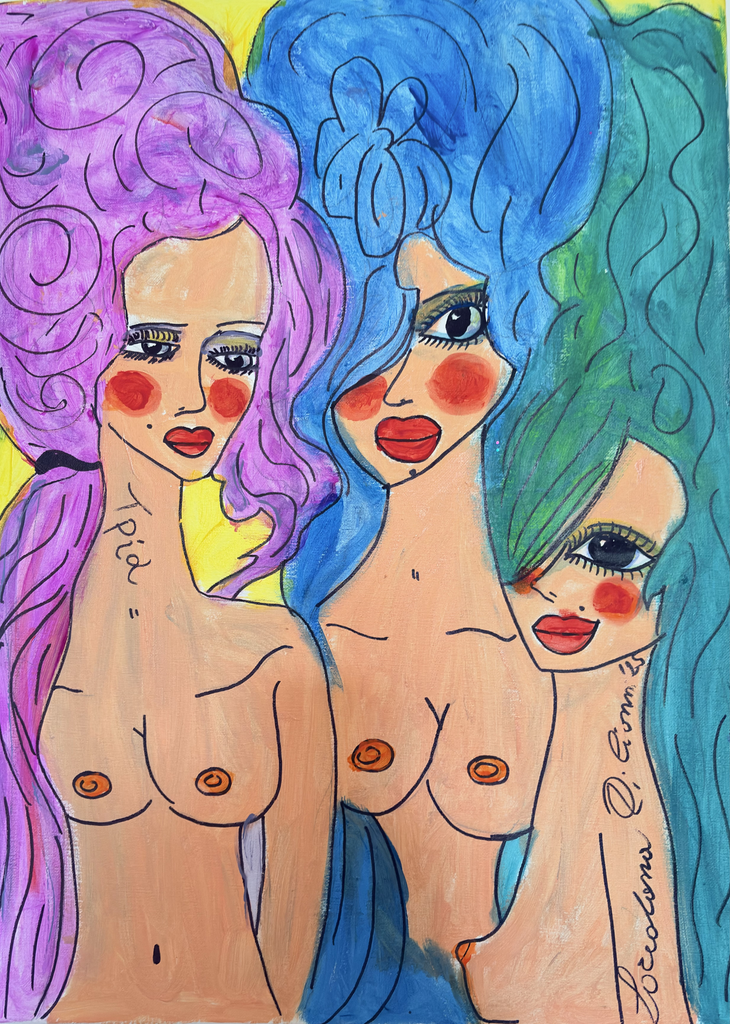
Seeing my ViVe exhibited in a gallery means witnessing an important transition, something born in an intimate and personal space suddenly becomes part of a shared space. During creation, the relationship with the work is very direct. There is me, the canvas, the gesture and everything that happens in that moment. When the painting is exhibited, a new phase begins , the work encounters people who observe it through their own sensitivity and their own story.
This is one of the most interesting aspects of art. A painting can be born from a deeply personal experience and manage to evoke very different emotions in those who look at it. When I recount that I paint with my eyes closed, curiosity often shifts from the result to the process. People want to understand how such a recognisable image can emerge through a gesture that gives up direct visual control.
For me it is important to tell about this way of working, but I would not want it to become the only element through which the works are read. The process is part of my research; the painting, once finished, must be able to live independently of the explanation of its origin. I like to think that each person can encounter a ViVa and recognise something different in her, perhaps something they did not know they carried inside themselves.
What does painting give you that nothing else can?
Painting allows me to come into contact with a part of myself that I cannot always reach through words. There are emotions that, when we try to explain them, seem to lose something of their complexity. Colour, gesture and form can instead allow them to exist without forcing them into a definition. Painting also means accepting that I do not always have all the answers. I can begin a work without knowing exactly where it will take me and discover, in the end, something I could not have planned.
Painting offers me a space of freedom, but also of listening. It teaches me to respect the timing of the process, to welcome the unexpected and not to consider every deviation an error. Perhaps what it gives me, more than anything else, is the possibility of transforming something invisible into a concrete presence, capable of being shared with others.
Walk us through the birth of a painting, from the moment a ViVa appears to the finished work.
The birth of a painting is a process that does not always follow a precise pattern, and it is precisely this that makes it interesting. Everything begins with the preparation of the canvas and the colours. I gradually enter my creative space and prepare myself to listen to what emerges, without necessarily establishing in advance which figure should appear.
I paint with my eyes closed, entrusting myself to the gesture and the memory of movement. The hand moves, the colour meets the surface and, through this succession of gestures, something begins to take shape. I do not always immediately know what the result will be. Sometimes a figure seems to emerge naturally; other times the image takes form through a more complex process.
The ViVa is born in this way, from the encounter between intention and the unexpected, between what I carry inside and what manifests itself on the canvas. When the painting is finished, the moment comes to confront the work in its visual dimension. This is a different step from creation, it means observing what has emerged, recognising its presence and understanding when the work can be considered complete.
Then comes the title, when it has not already appeared during the process. For me, giving a name to a work means opening another door, suggesting a direction without necessarily exhausting its meaning. Each ViVa is an encounter. And, as happens in the most important encounters, not everything can be foreseen in advance.
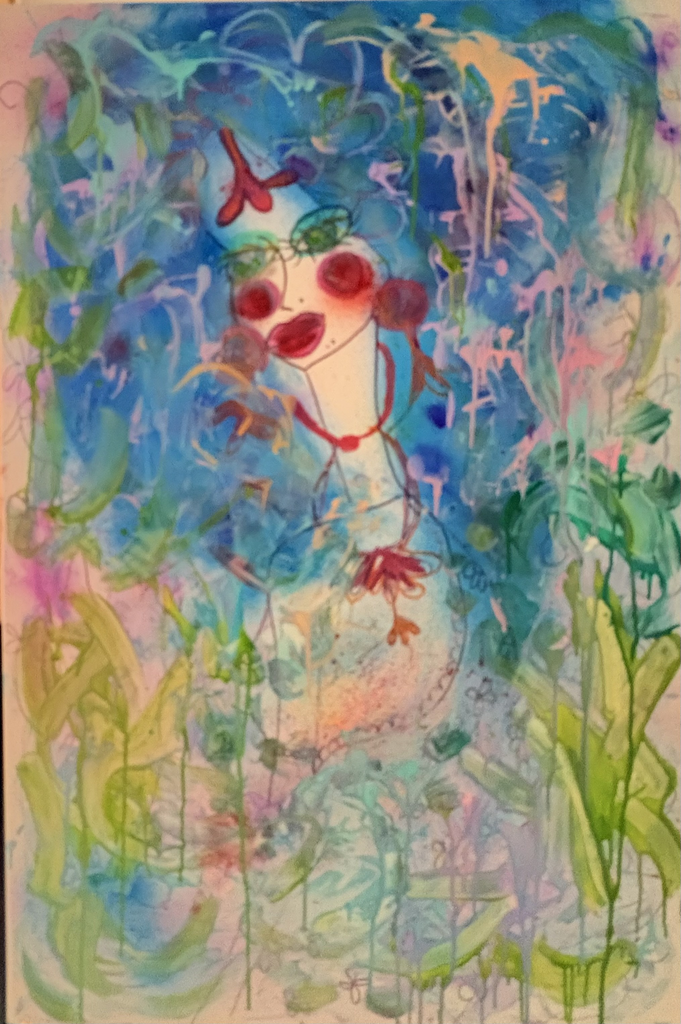
What do you hope someone feels when they stand in front of your work?
I do not wish to impose an emotion on those who look at my painting. I would rather that each person feels free to experience it in their own way. Someone might be attracted by the colours, someone by the expression of a ViVa, someone else might feel a sense of familiarity or, on the contrary, of mystery. I am interested in the work generating a relationship, in it not remaining merely something to observe, but becoming an occasion to feel, to remember, to imagine.
I would like those who stand before one of my ViVe to allow themselves a few moments without immediately seeking an explanation. Sometimes we are so accustomed to wanting to understand everything that we forget the possibility of simply allowing ourselves to be moved by an emotion. If one of my paintings manages to ignite a question, to awaken a memory or to make someone feel less alone in their own complexity, then I believe something significant has occurred. I am not looking for a single interpretation. I like to think that each person can encounter, in the same work, a different story.
What has being an artist taught you about yourself that nothing else could have?
Being an artist has taught me to listen to myself and to accept that not everything needs to be immediately comprehensible. I have learned that it is not always necessary to know where you are going in order to begin a journey. Sometimes you need the courage to make the first gesture, to leave space for uncertainty and to trust in what you do not yet know. Painting with eyes closed, for me, is also a metaphor for this attitude, it means stepping away, at least for a moment, from expectations and from the need to control every result.
Art has also taught me to embrace my contradictions, not to demand of myself that I always be the same person and to recognise that we can continuously transform ourselves. My ViVe remind me that inside each of us there are many voices, many nuances, many possibilities of being. If I were to summarise what I have learned, I would say that creating means having the courage to encounter what we do not yet know about ourselves. And perhaps this is the deepest meaning of my journey, to keep searching, without ever ceasing to be surprised.
Note: This interview was originally conducted in Italian. Read the original version →
Follow Loredana on Facebook Loredana Di Cianni
Enjoyed this format? Book your own Artist Interview or Solo Exhibition at Marea Gallery.
Apply here →
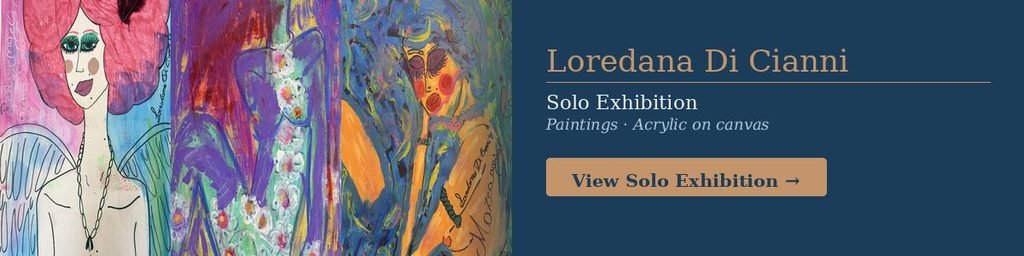
Loredana’s ViVe don’t stop here. Explore her full solo exhibition and see the paintings up close.